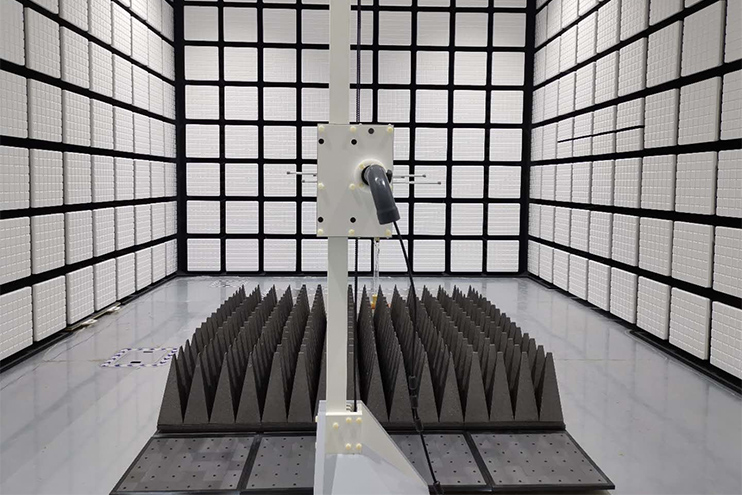
 Anechoic Chamber & Shielding Room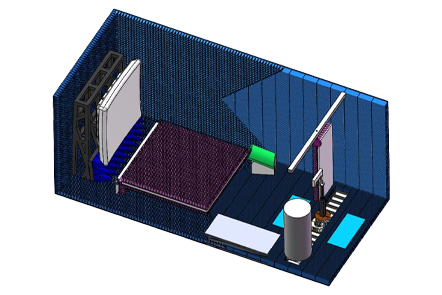
Main application areas
Satellites and aerospace: Used for measuring the antenna pattern and phase center of the entire satellite, and verifying on-orbit performance. For instance, satellite communication operators require that the products must pass the compression field test before leaving the factory.
Military field: RCS testing of radar stealth materials, electromagnetic compatibility (EMC) verification of weapon systems, such as optimization of stealth performance for F-35 fighter jets.
5G/6G communication: Base station antenna gain calibration, millimeter-wave band channel simulation, supporting the research and development of high-frequency communication technology.
Intelligent connected vehicles: testing of vehicle antennas, Beidou positioning, C-V2X communication performance, etc.
Key Parameters
1. Basic principle
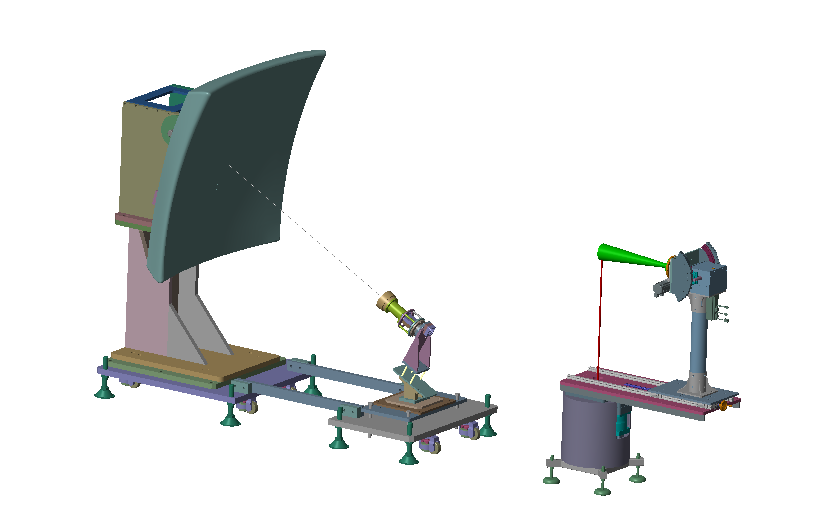
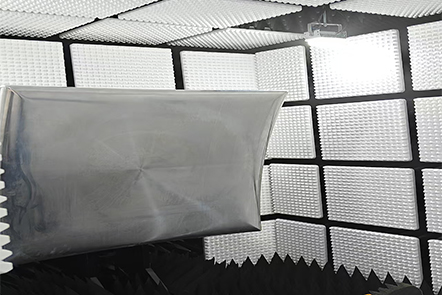
The compression field utilizes reflective surfaces (such as rotating parabolic surfaces or cylindrical surfaces) or lenses to convert the spherical waves emitted by the feed source into approximately uniform plane waves, placing the antenna or target under test in an electromagnetic environment similar to a far-field within a relatively close distance. For instance, a single-reflective surface compression field focuses spherical waves through a single reflective surface, while a double-reflective surface compression field (such as a Casseglenn system) further optimizes the quality of plane waves by the coordinated operation of the primary and secondary reflective surfaces.
2. Main advantages
Shorten the test distance: Compared with traditional far-field testing, the compact field can achieve high-precision measurement in a limited indoor space, and is particularly suitable for high-frequency band (such as millimeter-wave) antenna testing.
Environmental stability: The indoor anechoic chamber environment can shield external interference, reduce the influence of factors such as climate and background noise, and improve measurement repeatability and reliability.
Good confidentiality: The closed anechoic chamber design helps protect the sensitive information of the test subjects.
3. Key technical indicators
The quality of the quiet zone: It refers to the uniformity of the plane wave region, including amplitude fluctuations, phase errors, etc., which directly affects the measurement accuracy.
Frequency band width: Supported test frequency range. Modern compression fields can cover frequency bands from microwave to millimeter wave.
Cross-polarization isolation: It measures the degree of separation of signals with different polarization directions in a plane wave. High isolation can reduce measurement errors.