

 Anechoic Chamber & Shielding Room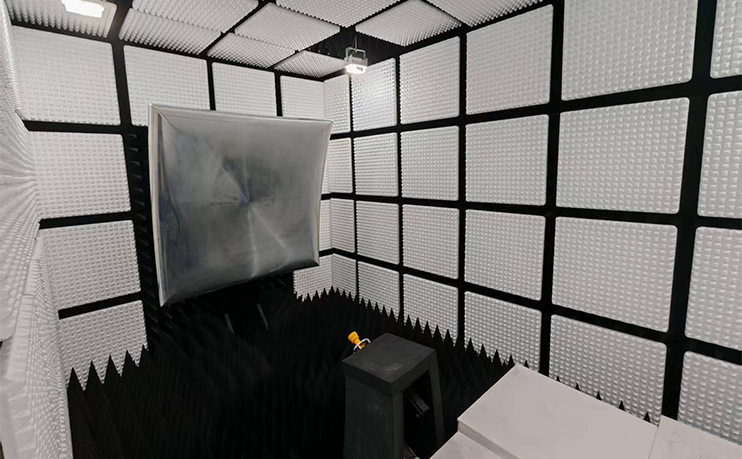
Main application areas
Widely used in aerospace, communication, automotive electronics and other fields, such as satellite whole satellite testing, 5G base station antenna research and development, intelligent car wireless communication performance verification, etc.
Key Parameters
1. Function and Role
It is mainly used to evaluate the radiation performance of antennas (such as pattern, gain, polarization, etc.) and the scattering characteristics (RCS) of radar targets. By simulating the far-field plane wave environment, the test results are ensured to be close to the actual application scenarios, especially suitable for the testing of high-gain, low-side lobe antennas and large-sized targets.
2. Technical principle
The spherical wave emitted by the feed source is converted into a plane wave by using a reflective surface (such as a rotating parabolic surface), forming a quiet zone (a test area without reflection interference). The edges of the reflective surface are designed with sawtooth or rolled edges to reduce diffraction interference. Meanwhile, the absorbing materials in the anechoic chamber absorb the excess reflected signals and lower the background level.
3. Advantage
Compact space: Compared with traditional far-field testing, the compact field can achieve high-precision testing in a smaller space, saving site resources.
Wide frequency band: Supports a wide range of frequency bands from low frequencies (such as 100MHz) to high frequencies (such as 200GHz), meeting the demands of emerging technologies like 5G millimeter wave.
Strong anti-interference ability: The anechoic chamber shields external electromagnetic interference, and the background level in the quiet zone is low (up to -60 DBSM to -70 DBSM), ensuring test stability.
All-weather operation: Unaffected by climate, it can efficiently complete testing tasks and is suitable for scientific research, production and certification scenarios.
4. Application scenarios
It is widely applied in fields such as aerospace, communication, and automotive electronics, for instance, in satellite whole-satellite testing, 5G base station antenna research and development, and wireless communication performance verification for smart vehicles.