

 Anechoic Chamber & Shielding Room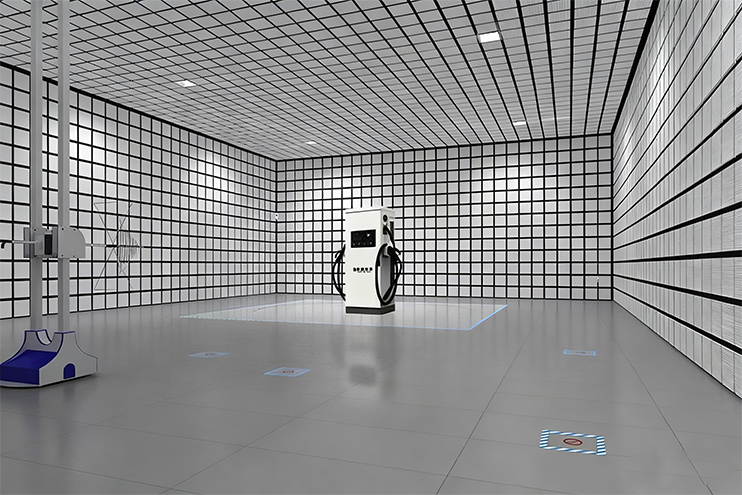
Main application areas
Suitable for the research and development, production, and certification of charging stations, especially for testing large charging stations (such as DC fast charging stations), a 10 meter anechoic chamber should be selected to meet far-field testing conditions; Small charging stations can use a 3-meter anechoic chamber.
Key Parameters
1. Basic Definition and Function
An anechoic chamber is a specially designed shielded space covered with absorbing materials, which can simulate a free space environment, eliminate electromagnetic wave reflection and external interference, and provide accurate and controlled testing conditions for the radiation emission and immunity testing of charging stations.
2. Main functions
Radiation emission test: Detect the electromagnetic energy radiated by the charging station to the outside during operation, ensuring compliance with relevant standards (such as CISPR, GB, etc.), and avoiding interference with surrounding electronic devices.
Radiation immunity test: Verify the stability and reliability of the charging station when subjected to external electromagnetic interference, ensuring its normal operation in complex electromagnetic environments.
3. Key components
Shielding housing: Constructed with metal materials (such as steel and copper), it forms a Faraday cage structure, effectively blocking external electromagnetic signals from entering the anechoic chamber while preventing internal signal leakage.
Absorbing materials: including ferrite tiles and conical carbon sponge absorbing materials, used to absorb electromagnetic waves of different frequencies, reduce reflections, and simulate free space environments.
Rotary table and antenna lifting tower: The rotary table is used to place charging piles and can rotate 360 ° for easy multi angle testing; The antenna lifting tower can adjust the antenna height to meet different testing distance requirements.
Testing equipment: such as signal generators, spectrum analyzers, receivers, etc., used to generate interference signals, measure electromagnetic field strength, etc.
4. Testing standards and requirements
The testing of charging stations shall comply with relevant international and domestic standards (such as GB/T 18487.2, CISPR, etc.), and specific limits shall be set for radiation emission and immunity in different frequency bands. For example, the radiation immunity requirement for charging piles in non residential environments is 10V/m in the 80MHz-1000MHz frequency band, while it is 3V/m in residential environments.