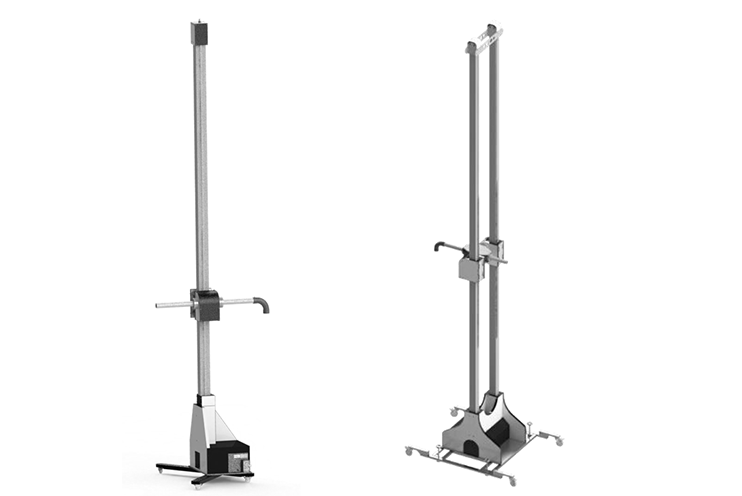
Components and Parts

product display
+

Antenna Masts

The anechoic chamber antenna tower is an important device in the anechoic chamber used to support and lift the antenna. Its main function is to ensure that the antenna can conduct precise electromagnetic tests at different heights and angles.

Features

Height adjustment

It is usually necessary to meet the lifting and lowering requirements of the antenna within a range of 1 to 4 meters to adapt to different frequencies and test scenarios.

Positioning accuracy

It supports 360° rotation, and the rotation accuracy is generally required to be within ±0.5° to ensure that the antenna can accurately align with the device under test.

Rotation function

Some antenna towers are equipped with a rotation function, which can adjust the horizontal Angle of the antenna to achieve multi-angle testing.

Automatic control

Supports remote control and automated operation, and can be programmed to automatically adjust height and Angle.

Specifications

1. Features
Height adjustment: It is usually necessary to meet the lifting and lowering requirements of the antenna within a range of 1 to 4 meters to adapt to different frequencies and testing scenarios.
Positioning accuracy: Supports 360 ° rotation, and the rotation accuracy is generally required to be within ± 0.5 ° to ensure that the antenna can accurately align with the device under test.
Rotation function: Some antenna towers are equipped with rotation function, which can adjust the horizontal angle of the antenna and achieve multi angle testing.
Automated Control: Supports remote operation and automation, enabling programmable automatic adjustment of height and angle.
Interface compatibility: It is equipped with multiple antenna interfaces and can be compatible with different models and types of antennas, such as log-periodic antennas, double-ridge waveguide antennas, etc.
2. Structure and Design
Antenna towers are usually made of metal or alloy materials, which have high strength and stability to ensure that they will not deform or vibrate in high field strength environments. Its structural design needs to consider electromagnetic compatibility to avoid interference with test results. Some antenna towers are also equipped with automatic control systems, which can remotely operate the lifting and rotation of antennas through software.
3. Application scenarios
Electromagnetic compatibility testing: In anechoic chambers such as 3-meter method and 10-meter method, it is used to measure the radiation emission and immunity performance of electronic equipment.
Antenna performance testing: Evaluate the radiation mode, gain, directionality, and other parameters of the antenna to provide data support for antenna design and optimization.
Wireless communication testing: Simulate actual communication environments to test the signal transmission and reception performance of wireless devices.
4.Collaborative work with other devices
The antenna tower needs to work in conjunction with equipment such as turntables, signal generators, and spectrum analyzers. The turntable is used to place the tested equipment and cooperate with the antenna tower to achieve all-round electromagnetic testing; Signal generators and spectrum analyzers are used to generate and analyze electromagnetic signals, working together to complete testing tasks.

Application scenarios

EMC Testing

Used to measure the radiation emission and anti-interference performance of electronic devices in radio anechoic chambers such as 3-meter and 10 meter methods.

Antenna Testing

Evaluate the radiation pattern, gain, directionality, and other parameters of the antenna to provide data support for antenna design and optimization.

Scientific Research Experiment

Simulate the actual communication environment and test the signal transmission and reception performance of wireless devices.